
From Monolithic SoC to Chiplet: Innovation of Heterogeneous SoC for Automotive Central Computing Platforms

From Monolithic SoC to Chiplet: Innovation of Heterogeneous SoC for Automotive Central Computing Platforms

Table of Contents

The semiconductor industry is currently facing a prominent structural contradiction. With the rapid advancement of intelligent driving, computing power demands have risen exponentially, soaring from dozens of TOPS for L2+ assisted driving to thousands of TOPS required for L4/L5 high-level autonomous driving. Meanwhile, Moore’s Law is approaching its physical limits, creating growing research and mass-production bottlenecks for advanced-process monolithic SoCs.

Monolithic SoCs integrating tens of billions of transistors on 2nm and 3nm processes require mask costs reaching tens of millions of US dollars, while chip yield declines exponentially with increasing integration density. Compared with consumer-grade chips, automotive chips impose far stricter industrial standards: they must deliver extreme AI computing performance while satisfying high reliability, wide-temperature resistance, and a 15-year extended service life requirement. In this context, Chiplet technology, initially adopted in data centers, has achieved large-scale deployment in automotive applications.

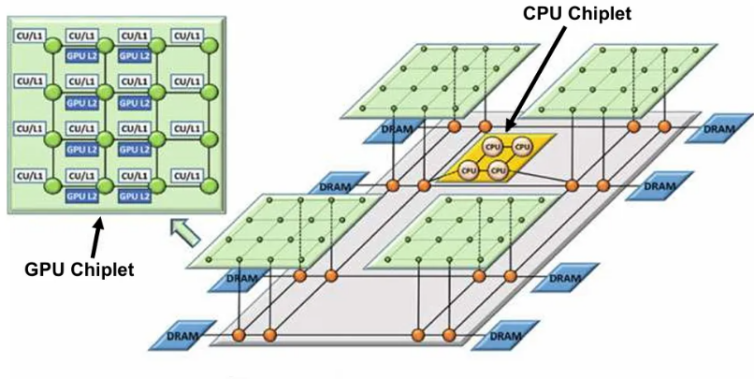
Breaking the traditional monolithic SoC design philosophy of integrating all functions on a single silicon die, the Chiplet architecture disassembles a complete chip system into multiple functionally dedicated bare dies and reintegrates them via advanced packaging technologies. This represents not only an upgrade in semiconductor manufacturing processes but also a disruptive transformation in chip architecture design, driving the industry’s evolution from function-defined architecture to connection-defined architecture.
I. Heterogeneous Chiplet SoC Architecture: An Optimal Customizable Solution

Traditional monolithic SoCs suffer from inherent design limitations, as all functional modules must share the same manufacturing process, making it impossible to balance performance, cost, and reliability. The core design philosophy of the Chiplet architecture is customization on demand and optimal ratio configuration. Its asymmetric process layout enables extreme adaptation for each functional module, perfectly matching the differentiated requirements of automotive central computing platforms.

1. Differentiated Process Deployment for Functional Chiplets

Compute Die: Adopts cutting-edge 3nm process technology, integrating automotive-optimized Arm Neoverse V3AE high-performance CPU clusters and NPU cores dedicated to large-model inference. As demonstrated by flagship automotive computing platforms such as NVIDIA Thor, advanced processes effectively suppress power overflow under full AI load and ensure stable high-performance computing for advanced intelligent driving.

I/O & Safety Die: Adopts mature and automotive-qualified 12nm/22nm processes, integrating analog circuits, power management modules, and ASIL-D compliant lock-step safety MCUs. For these modules, advanced processes deliver negligible area reduction while causing severe leakage current issues. Adopting mature processes significantly cuts R&D and manufacturing costs while leveraging superior process stability to meet the high-reliability and long-lifecycle requirements of automotive-grade chips.

2. Innovation in Storage Architecture: Breaking the Intelligent Driving Storage Wall
The core bottleneck of intelligent driving computing lies not in logical arithmetic capability, but in the high-speed transmission and reading/writing of massive perception data. In 2026, mainstream automotive chips adopt LPDDR5X/5T memory with a maximum data rate of 9.6Gbps, which still fails to meet the high-frequency data interaction demands of high-level intelligent driving.

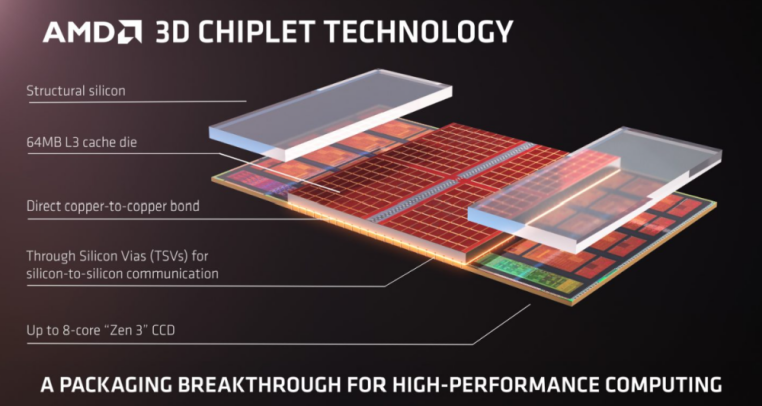
The Chiplet architecture adopts a near-memory computing design, physically aligning memory controllers with computing cores to shorten data transmission paths and reduce latency significantly. Meanwhile, the industry widely adopts AMD V-Cache style 3D-stacked SRAM technology, deploying high-capacity L3/L4 cache chiplets to minimize data exchange latency across dies. This provides a solid hardware foundation for high-frequency read-write AI algorithms such as timing anomaly detection and real-time environmental perception.

II. High-Speed Interconnection System: The Core Foundation of Chiplet Architecture

If functional chiplets serve as the core components of automotive SoCs, high-speed interconnection acts as the neural system that links all modules to achieve collaborative operation, directly determining the overall performance ceiling and system stability.

1. UCIe 2.0/3.0: The Universal Standard for Automotive Chiplet Interconnection

After years of industrial protocol iteration, UCIe (Universal Chiplet Interconnect Express) has become the de facto standard for automotive-grade Chiplet chips. Featuring decoupled physical and protocol layers, the UCIe architecture supports CXL and PCIe compatibility, delivering excellent ecological universality.

Mass-production automotive chips in 2026 are predominantly equipped with UCIe 2.0, while high-end flagship platforms have deployed UCIe 3.0 with optimized physical-layer anti-interference performance and robustness. Tailored for automotive extreme temperature conditions ranging from -40℃ to 125℃, UCIe integrates a runtime recalibration mechanism that dynamically adjusts signal drive strength and equalizer parameters according to ambient temperature. It maintains an extremely low bit error rate even at a ultra-high transmission rate of 64GT/s, fully adapting to complex automotive operating conditions.

2. Tiered Packaging Solutions: Balancing Performance and Cost

Packaging technology determines the ultimate performance of cross-chiplet interconnection. Currently, two mature tiered packaging solutions have been formed for automotive scenarios to meet the demands of different vehicle grades:

Passive Silicon Interposer (CoWoS-S): The most mature high-end packaging solution in the industry, achieving stable multi-chiplet interconnection through high-density wiring on silicon substrates with high bandwidth and outstanding stability, suitable for flagship high-level intelligent driving platforms.

Embedded Silicon Bridge (Si-Bridge): Inspired by Intel EMIB technology, this solution embeds miniature silicon slices only at chiplet docking positions. It retains high-bandwidth transmission capability while substantially reducing packaging costs, making it the mainstream cost-effective solution for mid-to-high-end vehicles in 2026.

III. Core Engineering Challenges of Automotive Chiplet Architecture

While the Chiplet architecture effectively resolves the computing power, cost, and process bottlenecks of traditional monolithic SoCs, it still faces multiple rigorous engineering challenges in latency, heat dissipation, power supply, and testing certification under strict automotive-grade standards.

1. Deterministic Latency Challenges Restricting Real-Time Computing Deployment

Cross-chiplet communication is not completely lossless. Engineering tests show that cross-die data access latency ranges from 5ns to 12ns, 2–3 times that of L3 cache latency in monolithic SoCs, accompanied by random jitter. For ultra-real-time autonomous driving algorithms such as planning and control, minor latency fluctuations may induce potential system risks.

Furthermore, heterogeneous multi-chiplet architectures rely on NoC (Network-on-Chip) to build a unified global memory address space. Managing cache consistency among heterogeneous CPU, GPU, and NPU cores and avoiding data deadlock and memory collapse constitute core architectural design challenges.

2. Power Supply and Thermodynamic Constraints Limiting Hardware Stability

Automotive computing chips feature ultra-compact size. Within a silicon area of less than 100 square millimeters, transient current dynamically switches between 30A and 60A, imposing extreme pressure on the power distribution network (PDN). Chiplets are interconnected via micro-bumps with limited current-carrying capacity, easily triggering IR-Drop voltage drop under full computing load, which may cause logical operation errors and system reboot failures.

In addition, heterogeneous chiplets suffer from uneven heat distribution: NPU cores generate high-temperature hotspots under heavy load, while adjacent I/O and safety die remain relatively cool. Thermal gradient-induced CTE (Coefficient of Thermal Expansion) mismatch generates continuous mechanical stress, which may fracture interconnection points during long-term operation. Precise thermal simulation modeling and dynamic thermal management scheduling algorithms are required for optimization.

3. KGD Quality Control Increases Supply Chain and Testing Difficulties

In traditional monolithic chip design, a single failed chip can be scrapped independently. In contrast, Chiplet packaging is an integrated structure: if any bare die fails after packaging, the entire high-cost packaged chip must be discarded, significantly increasing mass production losses.

Moreover, conventional ATE (Automatic Test Equipment) cannot detect internal interconnection links of multi-chiplet packages, making full hidden hazard inspection extremely difficult. The complexity of automotive-grade reliability testing has driven the deployment of new technologies such as AI-based real-time chip health prediction and link anomaly monitoring.

IV. SDV Software Definition: Shielding Hardware Complexity and Enabling Unified Computing Scheduling

To adapt to heterogeneous Chiplet architectures and lower upper-layer development thresholds, the SDV (Software-Defined Vehicle) system provides comprehensive supporting capabilities to transparently shield underlying hardware complexity.

On one hand, the Hypervisor virtualization layer abstracts the underlying Chiplet physical topology, shielding multi-die and multi-process hardware differences. Upper-layer autonomous driving applications access a unified computing resource pool without perceiving underlying hardware segmentation.

On the other hand, dedicated heterogeneous computing compilers intelligently split large-model operators and dynamically assign tasks to different chiplets based on computing power and bandwidth resources. The strategy of “parallel computing and data transmission” offsets additional latency caused by cross-chiplet interconnection and maximizes the computing potential of heterogeneous architectures.

V. Conclusion: Chiplet as the Inevitable Path for Automotive Central Computing

Modern automotive chip design has moved beyond the extensive model of simply stacking TOPS computing power. The Chiplet architecture delivers an innovative engineering logic: architecture follows connection, and function adapts to scenarios.

Through modular heterogeneous integration, Chiplet adopts advanced processes to meet the extreme computing demands of high-level intelligent driving, while leveraging mature processes to guarantee automotive functional safety and long-term reliability. Its flexible architecture adapts to iterating AI algorithms, perfectly balancing four core indicators: performance, cost, reliability, and service life.

In the wave of integrated automotive central computing evolution, Chiplet is not an optional technology, but an inevitable industrial upgrade path. Every optimization in latency, energy efficiency, and stability represents rigorous engineering practice that drives automotive semiconductor technology from theoretical research to large-scale industrial maturity.
Online Inquiry Form

Support Excel, PDF, CSV format files for full BOM list quotation

Submit your component procurement and custom packaging needs via the form below. We will provide a detailed quotation and professional solution within 1–8 working hours.

Service & Packaging

Materialparts is a professional electronic component supplier based in Shenzhen, China, with over 20 years of global trading experience. We integrate component procurement, quality inspection, technical support, customized packaging, and global delivery services to provide one-stop supply chain solutions. Our business covers industrial control, automotive electronics, consumer electronics, medical devices and other industries. We always adhere to genuine sources, stable supply and considerate after-sales service.

Core Services

1. One-stop Sourcing & BOM Support

We specialize in a full range of passive and active electronic components, including SMD resistors, power resistors, connectors, aviation connectors, LED beads, flexible circuit boards, printed circuit boards, and integrated circuits. Our professional team provides BOM list consolidation, component matching, and alternative model recommendation services. We support sample orders, small-batch trial production, and mass production orders with flexible MOQs to meet diverse procurement needs.

2. Genuine Product Guarantee & Full-process Quality Inspection

All products are sourced from official authorized channels and are 100% original genuine parts. Every batch of goods undergoes strict full-process quality inspection before delivery, with complete batch records and traceability documents provided. Our products comply with AEC-Q standards for automotive electronics and high-reliability specifications for medical devices. We eliminate counterfeits, refurbished parts and defective products from the source to secure your project production.

3. Fast Quotation & Order Processing

Our customer service team responds promptly to inquiries and quotation requests. All in-stock orders will be processed within one working day. We provide stocking reservation services for long-term cooperative customers, effectively solving problems such as component shortages and unstable supply chains.

4. Professional Technical Support

Our senior engineer team provides free technical consultation, model selection guidance and original manufacturer datasheets. We assist customers in solving problems related to product R&D, circuit design and component application, providing reliable technical support for project progress.

5. Sourcing for Special Components

Relying on our global supply chain network, we professionally source scarce components, obsolete parts and customized special components to efficiently solve your procurement difficulties.

6. Global Logistics & Document Services

We cooperate with mainstream international logistics providers including DHL, FedEx, UPS and TNT to achieve fast global delivery. We can provide complete export documents such as customs declaration files, commercial invoices and packing lists to ensure smooth customs clearance for international shipments. Local pickup is also available for customers in Shenzhen, China.

Professional Packaging Standards

Electronic components are sensitive to static electricity, collision, moisture and dust. We adopt industry-standard anti-static packaging solutions to fully ensure the integrity of goods during transportation and storage.

1. General Packaging Specifications

  • All components are packed separately to avoid damage caused by friction and collision;
  • Shockproof buffer materials are added for fragile products to ensure transportation safety;
  • Each package is clearly marked with part number, quantity, batch number and specifications for easy inventory counting and management.

2. Classified Professional Packaging

  • Anti-static Packaging: Static-sensitive components such as chips, circuit boards and sensors are packaged with anti-static bags, shielding boxes and conductive foam in strict accordance with international anti-static standards to prevent static damage.
  • Vacuum Moisture-proof Packaging: Moisture-sensitive components are vacuum-sealed with desiccants to isolate humid air, suitable for ocean transportation and long-term storage.
  • Original Factory Packaging: Integrated circuits of brands such as NXP are delivered with original reels, trays or tubes by default, retaining complete original packaging and adapting to automated SMT production lines.
  • Discrete Device Packaging: Discrete devices such as SMD resistors, power resistors and LEDs are quantitatively and classifiedly packaged with accurate quantity and clear marking.
  • Connector / Aviation Connector Packaging: Hard outer packaging is adopted to prevent pin bending and structural deformation.

3. Custom Packaging Services

We provide value-added services including personalized packaging, custom labeling and re-reeling according to customer requirements, fully matching your production and warehouse management standards.

Contact Information

For service consultation or packaging customization, please feel free to contact us:
Email: [email protected]
Tel / WhatsApp: +86 13760382860
Address: Room 2919, Guoli Building, Huaqiang North, Futian District, Shenzhen, Guangdong, China
 
Shipping & Payment

Materialparts is a professional global supplier of electronic components with over 20 years of industry experience. We provide one-stop supply of passive components, integrated circuits, as well as parts for industrial control, automotive electronics, consumer electronics and medical devices. Below are the unified shipping and payment policies applicable to all orders, samples and bulk purchases worldwide.

1. Payment Terms

We offer a variety of secure and convenient payment methods to meet diverse business cooperation needs. Details are as follows:
  1. Accepted Payment Methods
  • T/T (Bank Wire Transfer): The primary settlement method for bulk orders and a widely used international payment channel.
  • PayPal: Ideal for small orders, sample orders and quick payments.
  1. Settlement Currency


    US Dollar (USD) is the default settlement currency. RMB is available for domestic customers.

  2. Bank Charges


    All transfer fees, intermediary bank charges and other remittance-related expenses shall be borne by the buyer.

  3. Payment Requirements
  • Sample and small orders: Shipment will be arranged upon full payment.
  • In-stock bulk orders: Goods will be delivered within 2 to 3 working days after full payment.

2. Shipping & Delivery

We partner with leading global logistics providers to ensure safe and fast delivery worldwide. Relevant details are listed below:
  1. Logistics Partners
  • International Express: DHL, FedEx, UPS, TNT
  • Economy Logistics: Air freight and sea freight for large-volume cargo
  • Domestic Delivery: SF Express, Yunda Express
  1. Order Processing Time
  • In-stock items: Orders confirmed and fully paid before 14:00 (GMT+8) will be shipped on the same day. All other orders will be dispatched within 1 to 2 working days.
  • Out-of-stock or sourced items: The delivery lead time will be confirmed separately according to brand and inventory status.
  1. Estimated Transit Time
  • International Express: 3 – 7 working days globally
  • Air Freight: 7 – 12 working days
  • Sea Freight: 25 – 40 working days for heavy and large bulk cargo
  1. Shipping Fee Rules
  • Shipping cost is calculated based on package weight, volume, destination and delivery method.
  • Both freight prepaid and freight collect are available. Please provide your courier account number in advance if you choose freight collect.
  • Free international express delivery is offered for large orders. Terms for long-term partners can be negotiated separately.
  1. Shipment Tracking
     

    Within 24 hours after dispatch, we will send the tracking number, commercial invoice, packing list and other documents to your email or communication account. You may check the shipment status online in real time.

3. General Order Rules & Notes

  1. MOQ & Sample Service


    We support flexible minimum order quantities for samples, small-batch and large-batch orders. All sample orders shall comply with the above shipping and payment policies.

  2. Packaging Standard


    All electronic components are packed with professional anti-static and shockproof materials. Original factory packaging is available for branded chips and integrated circuits.

4. Customs & Liability Statement

  1. Import Duties & Taxes


    All import duties, customs clearance fees and local taxes incurred for international shipments shall be borne by the buyer. We will provide complete customs documents to assist you with clearance procedures.

  2. Handling of Lost or Damaged Goods
  • In case of loss or severe damage during transit, please contact us within 48 hours after receiving the tracking information. We will assist you in filing a claim with the logistics provider.
  • We shall not be liable for any losses caused by incorrect delivery address, wrong contact information or the buyer’s refusal to complete customs clearance.

5. Local Pickup in Shenzhen

Local pickup service is available for customers in Shenzhen and surrounding areas:
  • Address: Room 2919, Guoli Building, Huaqiang North, Futian District, Shenzhen, Guangdong Province, China
  • Business Hours: 09:00 – 18:00, Monday to Friday. Closed on weekends and official public holidays.
  • Notice: Please make an appointment via email or communication tools one day in advance, and present your order information upon pickup.

Contact Information

Email: [email protected]

Tel / WhatsApp: +86 13760382860

Quality Assurance

Quality is the core foundation of our long-term global cooperation. With over 20 years of experience in the electronic component industry, Materialparts has built a strict and standardized quality management system covering component sourcing, incoming inspection, full-batch testing, packaging and delivery. We are committed to delivering 100% genuine, high-reliability electronic components for industrial control, automotive electronics, consumer electronics and medical device industries, and fully safeguarding your production and R&D projects.

1. Authorized & Genuine Sourcing Promise

All of our electronic components are procured from official authorized distributors and original manufacturers. We strictly reject counterfeits, refurbished parts, disassembled components and gray-market goods. Every product is guaranteed to be brand-new original parts and fully consistent with the original technical parameters. For branded products such as NXP IC series, we maintain complete supply channel documents to realize full product traceability.

2. Strict Full-batch Quality Inspection

We implement 100% full-batch quality control for all goods before shipment. Our professional QC team conducts multi-dimensional tests including appearance inspection, electrical parameter testing, performance verification and packaging check. Each batch of components is attached with complete inspection reports and batch records. We stick to zero-tolerance standards for defective products to ensure every piece of component meets industrial application requirements.

3. Industry Standard Compliance

Our products comply with a variety of international industry quality standards to adapt to high-standard application scenarios:
  • Automotive Electronics: All automotive-grade components pass AEC-Q series certification, featuring excellent stability and durability to adapt to complex vehicle operating environments.
  • Medical Devices: High-reliability components meet medical industry safety and compliance regulations, ensuring stable operation for medical equipment.
  • Industrial Control & Consumer Electronics: Products conform to universal international electronic industry standards, suitable for long-term continuous operation of various equipment.

4. Professional Reliability Control

For static-sensitive, moisture-sensitive and precision components such as ICs, PCBs, sensors and connectors, we carry out reliability screening in advance. Combined with standardized ESD anti-static packaging and vacuum moisture-proof packaging, we avoid component damage caused by static electricity, dampness or collision during storage and transportation, and retain the original performance of products.

5. Traceability Management System

We establish a complete product traceability system. Each batch of goods corresponds to independent batch number, sourcing record, inspection record and delivery record. Customers can query the whole lifecycle information of components at any time. This system effectively solves quality risks and facilitates after-sales handling and production quality control for your company.

6. After-sales Quality Guarantee

If any product is confirmed to have non-conformity quality problems due to our reasons after receipt, we provide free return, exchange and supplementary delivery services. Our professional quality team will also conduct root cause analysis to optimize our quality control process. We respond to quality feedback within 24 hours to resolve your worries efficiently.

Contact Us

If you have inquiries about our quality standards, inspection procedures or product certification documents, please feel free to contact us:


Email: [email protected]
Tel / WhatsApp: +86 13760382860
Address: Room 2919, Guoli Building, Huaqiang North, Futian District, Shenzhen, Guangdong, China