
2026’s most impressive industry report card in the AI space undoubtedly belongs to NVIDIA.
NVIDIA’s newly released Q2 earnings report for Fiscal Year 2027 (ending July 26, 2026) has set a new record for the global tech industry. The company posteda record-breaking quarterly revenue of $96.22 billion (approximately ¥646.8 billion), representing a staggering 106% year-over-year surge, with profits doubling in tandem. Even more striking is NVIDIA’s bold long-term growth forecast — revenue is expected to rise another 70% in Fiscal Year 2028, signaling that the AI computing dividend is far from exhausted.
Behind these outstanding figures lies the full-scale boom of global AI infrastructure. Nevertheless, extreme supply chain pressure, insufficient production capacity, and rising raw material costs have emerged as core bottlenecks limiting NVIDIA’s further expansion. This article breaks down the key highlights, growth logic, and hidden risks of this explosive earnings report in plain language.
1. Blowout Financials: Revenue, Profit and Gross Margin All Beat Expectations
NVIDIA delivered an almost perfect quarterly performance, with all core financial metrics significantly exceeding market forecasts and maintaining robust, unabated growth momentum.
In terms of revenue, the $96.22 billion quarterly result marks a 106% year-over-year increase and an 18% quarter-on-quarter rise, surpassing analysts’ consensus estimate of $92 billion. The company is now on the verge of hitting the milestone of$100 billion in single-quarter revenue.
Its profitability is equally remarkable. Under GAAP standards, net income soared 126% year-over-year to $59.7 billion. Non-GAAP adjusted net income reached $53.95 billion, up 118% year-over-year, while adjusted earnings per share (EPS) jumped 120% year-over-year, outperforming market expectations by a wide margin.
The most telling indicator of NVIDIA’s dominant market power is itsindustry-leading 75% gross margin. Sustaining such a high and stable profit margin in the hardware manufacturing sector is extremely rare, fully demonstrating NVIDIA’s absolute pricing power and irreplaceable position in the AI accelerated computing track.
NVIDIA’s explosive growth is primarily fueled by its data center business, the most intuitive reflection of booming global AI computing demand.
The data center segment generated $89 billion in revenue this quarter, up 117% year-over-year and 18% quarter-on-quarter, accounting for 92.5% of NVIDIA’s total revenue and contributing nearly all of the company’s revenue growth.
The evolving customer structure reveals a major shift in AI industry penetration. In the past, computing procurement was dominated solely by top-tier tech giants, while AI adoption has now expanded comprehensively across industries. Hyperscale cloud vendors contributed $48.7 billion in revenue, remaining the primary buyers of AI computing power. Meanwhile, revenue from industrial enterprises, AI startups, and government and corporate AI projects reached $40.3 billion, surging 138% year-over-year and 25% quarter-on-quarter.
This indicates that AI computing power is no longer exclusive to tech giants but has become essential infrastructure for all industries, marking a genuine industrial inflection point.
On the product side, next-generation technologies continue to drive performance growth. Blackwell architecture products serve as the main revenue pillar, while the highly anticipated Vera Rubin platform has entered full-scale mass production and is expected to become NVIDIA’s fastest-volume product launch to date. Currently, Vera Rubin racks are deployed at major global cloud partners including CoreWeave, Google Cloud, Microsoft Azure, and Oracle Cloud Infrastructure. Additionally, the edge computing business achieved steady growth with $7.2 billion in revenue (up 27% year-over-year), driven by strong sales of Blackwell workstations. NVIDIA has also launched the industry’s first full-stack physical AI security system NVIDIA Halos for Robotics and partnered with Microsoft on the NVIDIA RTX Spark superchip, redefining Windows PC intelligent capabilities.
3. Strong Long-Term Outlook: 70% Revenue Growth Projected for FY2028 with Sustained AI Dividends
The biggest highlight of this earnings release is NVIDIA’s rare early release of long-term performance guidance, significantly lifting global AI industry growth expectations. The company forecasts a 70% overall revenue increase for Fiscal Year 2028, far exceeding the previous market consensus forecast of 45%.
For the upcoming quarter, NVIDIA expects mid-point revenue of $108 billion, representing a 90% year-over-year increase and officially ushering in the era of $100 billion quarterly revenue.
This aggressive growth forecast is backed by highly certain market demand. NVIDIA’s outstanding cloud service order backlog has exceeded $2 trillion. Capital expenditures by top global hyperscale cloud vendors are projected to reach nearly $800 billion in 2026 and $1.3 trillion in 2027.
Furthermore, the commercial value of computing power continues to rise. Revenue per gigawatt of computing power has jumped from $18 billion in the Hopper era to $40 billion in the new Vera Rubin era. As Jensen Huang stated, AI has reached an industrial turning point, where generative AI outputs deliver tangible productivity and commercial value, ushering in an era where “computing power equals revenue”.
4. The Only Growth Constraint: Supply Chain Bottlenecks Limit Further Expansion
Despite explosive demand growth, NVIDIA openly acknowledges that extreme supply chain pressure is the sole bottleneck restricting its performance expansion, a situation that will persist at least through Fiscal Year 2028.
The core industry constraint lies in high-end memory chips, especially HBM (High-Bandwidth Memory), which faces severe supply shortages and soaring prices, with upward price trends expected to continue next year. Driven by rising raw material costs and tight production capacity, NVIDIA’s gross margin will face short-term pressure, projected to drop to 71%–72% in Q4 FY2027 before recovering to 72%–73% in FY2028.
Notably, this round of explosive growth has not relied on revenue from the Chinese market. Due to U.S. export control regulations, NVIDIA delivered a small batch of compliant Hopper 200 products to Chinese clients this quarter, accounting for less than 1% of its data center revenue and totaling under $890 million. This means NVIDIA still retains untapped growth potential, with room for further expansion if market policies improve.
5. Conclusion: The AI Industry Enters an Accelerated Era with Coexisting Opportunities and Barriers
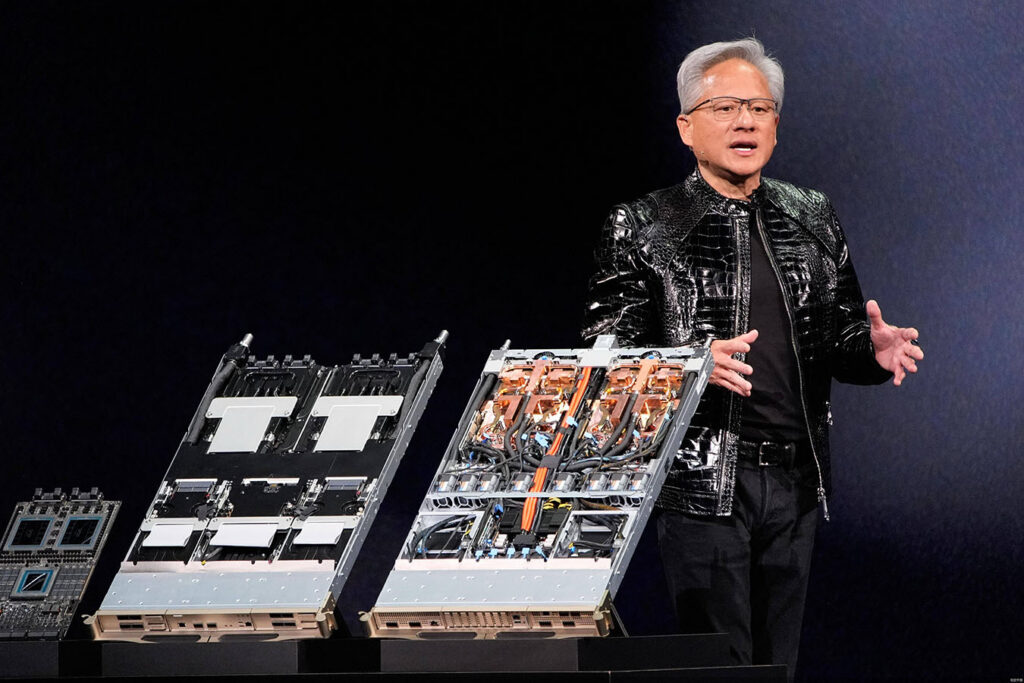
NVIDIA’s stunning earnings report is more than just a corporate performance update — it serves as the strongest indicator of global AI industry prosperity.
On one hand, AI commercialization is accelerating across cloud models, industrial scenarios, terminal devices, and government applications, creating sustained and rigid demand for computing power with high growth certainty for years to come. On the other hand, core supply chain barriers in high-end chips, advanced memory, and cutting-edge processes continue to intensify, with capacity shortages and rising costs becoming long-term industry challenges.
In a market defined by skyrocketing demand and constrained supply, NVIDIA will continue to lead the AI computing track. However, the speed of supply chain breakthroughs will ultimately determine its growth ceiling. For the entire tech industry, competition over AI computing infrastructure has only just entered its fiercest phase.