


Product Overview
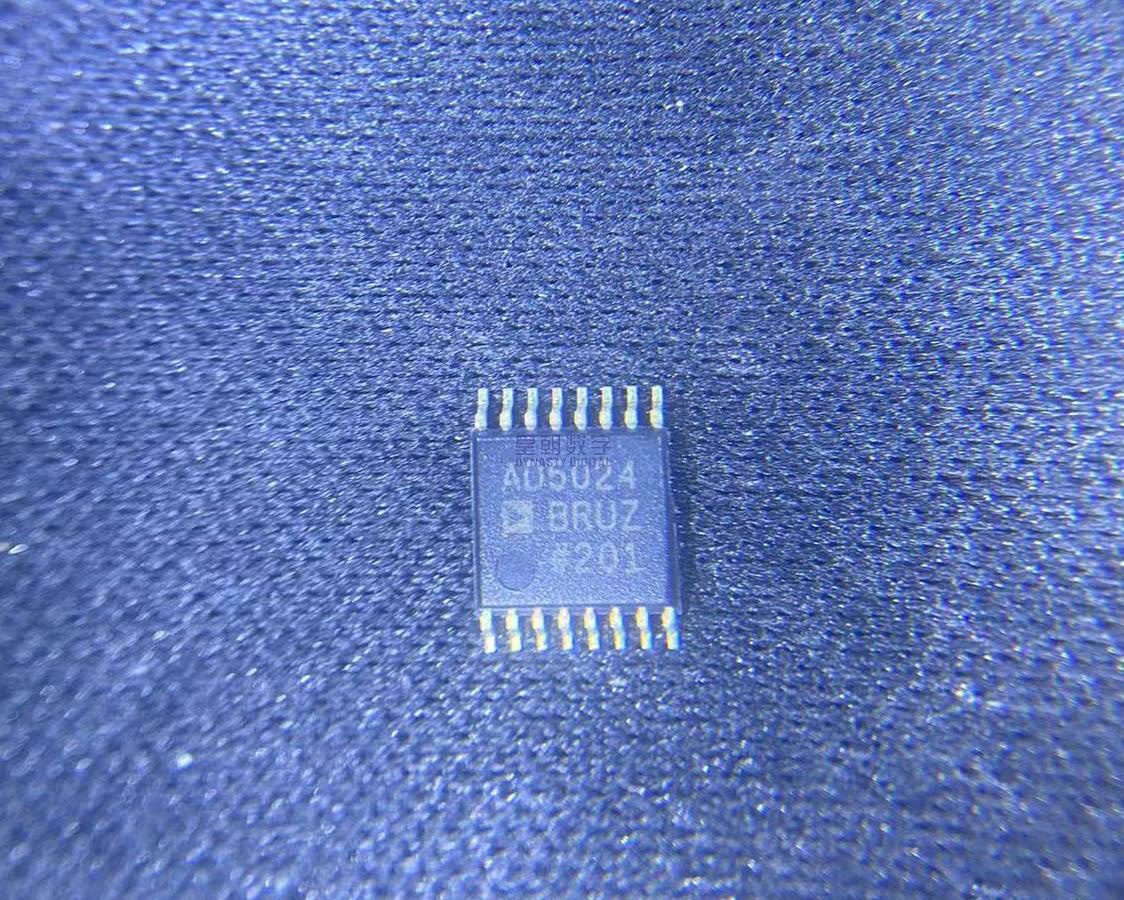
The AD5024BRUZ is a low-power, quad-channel 12-bit buffered voltage output DAC (digital-to-analog converter) from Analog Devices’ nanoDAC® family. Part of the AD5024/AD5044/AD5064 pin-compatible family, the AD5024 offers 12-bit resolution with ±1 LSB integral nonlinearity (INL) and differential nonlinearity (DNL) specifications, making it a fully accurate DAC suitable for precision applications. The device operates from a single 4.5V to 5.5V supply and features individual reference voltage pins for each DAC pair, providing design flexibility. A versatile 3-wire SPI-compatible serial interface operates at clock rates up to 50 MHz, compatible with standard SPI, QSPI™, MICROWIRE™, and DSP interface standards. Integrated reference buffers and output amplifiers simplify system design by eliminating the need for external buffering. The AD5024BRUZ incorporates a power-on reset circuit ensuring outputs power up to zero scale or midscale, three power-down modes reducing current consumption to typically 400 nA at 5V, hardware LDAC with software override, a CLR function with programmable clear code, and an SDO output for daisy-chaining multiple devices. Packaged in a 16-lead TSSOP and specified over the -40°C to +125°C industrial temperature range, the AD5024BRUZ is ideal for process control, data acquisition systems, portable battery-powered instruments, digital gain and offset adjustment, programmable voltage/current sources, and programmable attenuators.
Key Specifications
| Parameter | Value |
| Resolution | 12 bits |
| Number of Channels | 4 (Quad) |
| Architecture | Voltage Output DAC with Output Buffer (nanoDAC®) |
| Integral Nonlinearity (INL) | ±1 LSB (max) |
| Differential Nonlinearity (DNL) | ±1 LSB (max) |
| Supply Voltage Range | 4.5 V to 5.5 V (single supply) |
| Reference Pins | Individual reference pins per DAC pair (VREFA, VREFB, VREFC, VREFD) |
| Output Type | Buffered voltage output, rail-to-rail |
| Output Swing | 0 V to VREF (rail-to-rail operation) |
| Interface | 3-wire serial (SPI, QSPI, MICROWIRE, DSP compatible) |
| Maximum Serial Clock | 50 MHz |
| Settling Time | 10 µs typ to 1/2 LSB (full-scale step) |
| Digital Glitch Impulse | 2 nV-s (typ) |
| DC Power-On Glitch | Very low glitch at power-up |
| Quiescent Current | 360 µA (typ) @ 5V; 480 µA (max) |
| Power-Down Current | 400 nA (typ) @ 5V in power-down mode |
| Power-Down Modes | 3 modes: 1kΩ to GND, 100kΩ to GND, high impedance |
| Power-On Reset | Zero scale or midscale (selectable via POR pin) |
| LDAC Function | Hardware LDAC pin with software LDAC override |
| CLR Function | Asynchronous clear to programmable code |
| Daisy-Chain | SDO pin supports multiple devices in series |
| Operating Temperature | -40°C to +125°C |
| Package | 16-Lead TSSOP (RU-16) |
| Total Unadjusted Error (TUE) | < 2 mV |
Features
- Quad 12-bit buffered voltage output DAC in compact 16-lead TSSOP
- ±1 LSB INL and DNL for high accuracy applications
- Pin-compatible upgrade to AD5666 with better performance
- Individual reference pins per DAC pair for flexibility
- Rail-to-rail output operation with integrated output amplifier
- Single 4.5V to 5.5V power supply
- Power-on reset to zero scale or midscale (selectable)
- 3 power-down modes plus per-channel power-down capability
- Hardware LDAC with software LDAC override function
- CLR function that clears to programmable DAC code
- SDO output for daisy-chaining multiple devices
- High-speed serial interface up to 50 MHz
- Schmitt trigger inputs for noise immunity
- Internal reference buffer on all reference inputs
- Very low glitch on power-up and code transitions
- Total unadjusted error (TUE) less than 2 mV
- Specified over -40°C to +125°C industrial temperature range
Applications
- Process control and industrial automation
- Data acquisition systems and instruments
- Portable battery-powered test and measurement equipment
- Digital gain and offset voltage adjustment
- Programmable voltage and current sources
- Programmable attenuators and filters
- Sensor calibration and trimming
- Motor control bias and reference generation
- Optical module bias control
- Automotive electronics