


Product Overview
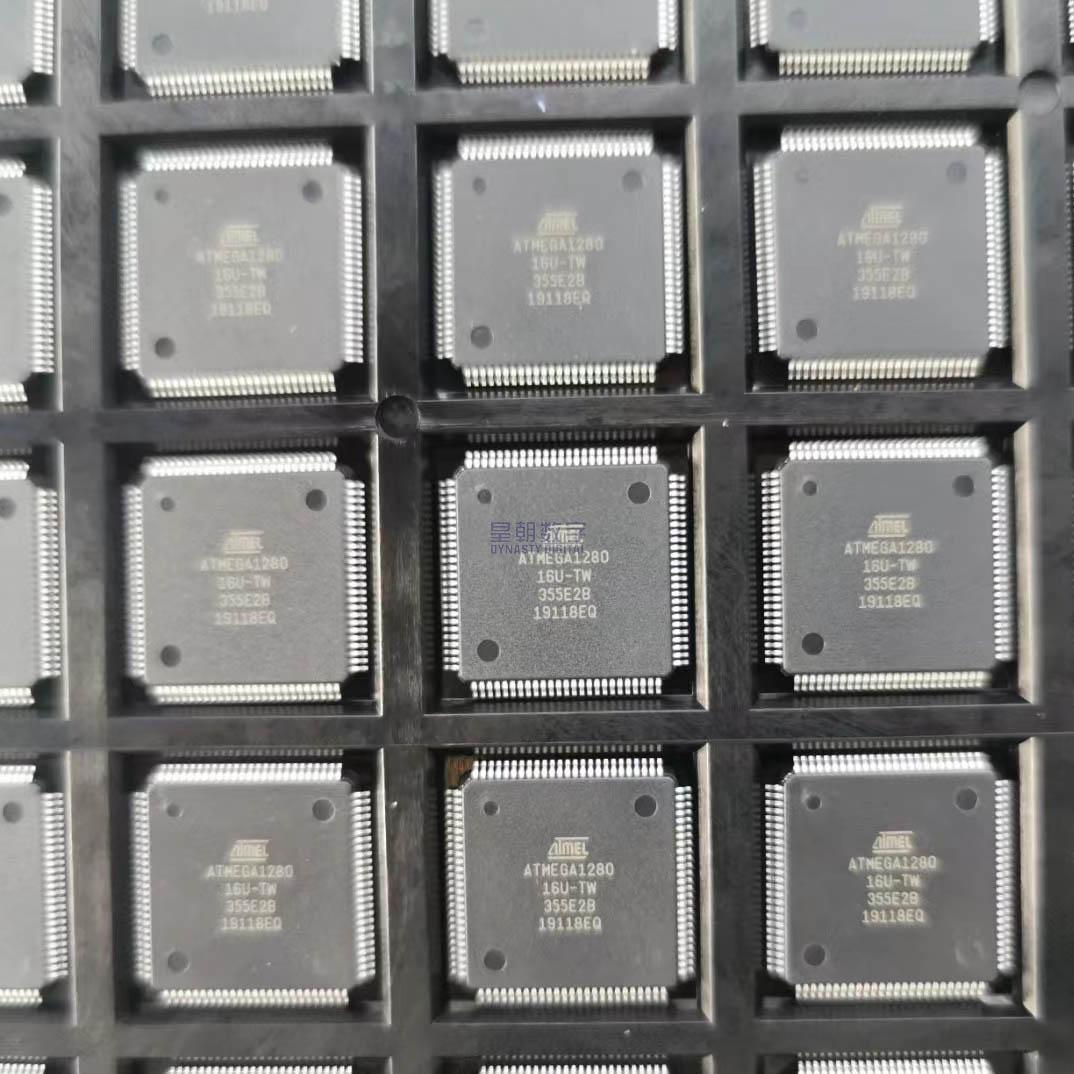
The ATMEGA1280-16AU is a high-performance, low-power 8-bit AVR RISC-based microcontroller from Atmel (now Microchip). Featuring 128KB of ISP Flash memory, 8KB of SRAM, and 4KB of EEPROM, this device is the 100-pin version of the popular ATmega series — famously used as the core of the Arduino Mega development board. The ATmega1280 achieves a throughput of 16 MIPS at 16MHz by executing powerful instructions in a single clock cycle. The device provides an extensive set of peripherals including 86 general purpose I/O lines, six flexible timer/counters with compare modes and PWM, four USARTs, a byte-oriented Two-Wire serial interface (I2C), a 16-channel 10-bit A/D converter, and a JTAG interface for on-chip debugging. The JTAG interface also provides boundary-scan capabilities and programming of Flash, EEPROM, fuses, and lock bits. Additional features include an on-chip analog comparator, internal calibrated RC oscillator, power-on reset, programmable brown-out detection, and six sleep modes. Operating from 2.7V to 5.5V, the ATmega1280-16AU is packaged in a 100-pin TQFP (14x14mm) and supports industrial temperature range (-40 to +85°C). With its abundant I/O and rich peripheral set, the ATmega1280 is ideal for complex embedded projects requiring numerous connections and communication interfaces.
Key Specifications
| Parameter | Conditions | Min | Typ | Max | Unit |
| Core Architecture | 8-bit AVR RISC | ||||
| Clock Frequency | 16AU speed grade | 0 | 16 | MHz | |
| Throughput | @ 16MHz | 16 | MIPS | ||
| Instruction Set | 133 instructions, most single-cycle | ||||
| Working Registers | General purpose | 32 x 8-bit | |||
| Flash Program Memory | ISP | 128 KB (64K x 16) | |||
| Flash Endurance | 10000 | cycles | |||
| Boot Loader Section | Independent lock bits | Yes (optional Boot Code) | |||
| SRAM (Internal RAM) | 8 KB (8192 bytes) | ||||
| EEPROM | Data storage | 4 KB (4096 bytes) | |||
| EEPROM Endurance | 100000 | cycles | |||
| I/O Pins | 86 general purpose I/O lines | ||||
| I/O Ports | 11 ports (PA-PK, plus additional) | ||||
| Timer/Counter Total | 6 timer/counters | ||||
| 8-bit Timer/Counter 0 | With prescaler, compare mode | 1 (T/C0) | |||
| 8-bit Timer/Counter 2 | Async capable | 1 (T/C2) | |||
| 16-bit Timer/Counter 1 | 3 compare, 1 capture | 1 (T/C1) | |||
| 16-bit Timer/Counter 3 | 3 compare, 1 capture | 1 (T/C3) | |||
| 16-bit Timer/Counter 4 | 3 compare, 1 capture | 1 (T/C4) | |||
| 16-bit Timer/Counter 5 | 3 compare, 1 capture | 1 (T/C5) | |||
| PWM Channels | 15 PWM channels (standalone) | ||||
| USART | Full duplex | 4 USARTs (USART0-USART3) | |||
| SPI | Master/Slave | 1 SPI interface | |||
| Two-Wire Interface (TWI) | I2C compatible | 1 TWI | |||
| ADC Resolution | Successive approximation | 10-bit | |||
| ADC Channels | Single-ended | 16 channels | |||
| Analog Comparator | 1 (on-chip) | ||||
| Watchdog Timer | Programmable, on-chip osc | Yes | |||
| Real Time Counter | Separate oscillator | Yes (RTC) | |||
| JTAG Interface | IEEE 1149.1 | Yes (boundary scan + debug) | |||
| External Interrupts | 8 external interrupt pins | ||||
| Interrupt Sources | Multiple, with 4-level priority | ||||
| Power-On Reset | Yes (POR) | ||||
| Brown-out Detection | Programmable | Yes (BOD) | |||
| Internal RC Oscillator | Calibrated | Yes (8MHz) | |||
| Operating Voltage | 2.7 | 5.5 | V | ||
| Sleep Modes | 6 modes (Idle, ADC NR, Power-save, Power-down, Standby, Ext Standby) | ||||
| Operating Temperature | Industrial | -40 | +85 | °C | |
| Package | TQFP-100 (14x14mm) | ||||
Features
- High-performance, low-power AVR 8-bit RISC architecture
- 133 powerful instructions — most single clock cycle execution
- 32 x 8 general purpose working registers
- 16 MIPS throughput at 16 MHz
- On-chip 2-cycle multiplier
- 128KB In-System Programmable (ISP) Flash
- 10,000 Flash write/erase cycles
- Optional Boot Code section with independent lock bits
- True Read-While-Write operation
- 8KB internal SRAM
- 4KB EEPROM (100,000 write cycles)
- Up to 64KB optional external memory space
- Programming lock for software security
- JTAG (IEEE std. 1149.1 compliant) interface
- Boundary-scan capabilities
- Extensive on-chip debug support
- 86 programmable I/O lines
- Two 8-bit Timer/Counters with separate prescalers
- Four 16-bit Timer/Counters with compare and capture modes
- Real Time Counter with separate oscillator
- 15 PWM channels with programmable resolution
- 16-channel 10-bit ADC
- Byte-oriented Two-Wire serial interface (I2C)
- Four programmable serial USARTs
- Master/Slave SPI serial interface
- Programmable Watchdog Timer with on-chip oscillator
- On-chip analog comparator
- Power-on Reset and programmable Brown-out Detection
- Internal calibrated RC oscillator
- Six software-selectable sleep modes
- QTouch library support (capacitive touch)
- Wide operating voltage: 2.7V to 5.5V
- Industrial temperature range (-40 to +85°C)
- 100-pin TQFP (14x14mm) package
Applications
- Arduino Mega-compatible projects
- Industrial control systems
- Robotics and mechatronics
- 3D printers and CNC machines
- Home automation and smart home
- IoT gateway devices
- Data acquisition and logging
- Motor and servo control
- LCD and touchscreen interfaces
- Medical devices
- Automotive systems
- Consumer electronics
- Educational platforms